

How can you decorate a boy’s bedroom around his interests?

Your boy loves animals but prefers yellow to blue? His bedroom can reflect that. For a primary school child, start with a picture he chooses himself, then match the frame and a few details to the furniture already there.
Between six and eleven, books, building projects and first collections take up as much space as decoration. Here is how to make room for prints in this busy space, with four pictures and a comparison of frames.
Choose a story he enjoys together
Show a small selection and ask what he notices: an animal, a colour, a funny detail? The answer is more useful than a theme chosen purely for his age. Children’s bedroom prints let you start with his interests. Keep the books and objects he treasures, even when their colours do not all match the new picture.
Animal prints suit children who enjoy creatures; astronaut posters open another world. One picture can suggest an interest without repeating its motif on curtains, rug and bed. Reserve a place for his own drawings: his room should welcome what he makes, as well as what you buy.
Leave a wall for looking and a desk for working
Find a wall visible from his reading corner or the doorway. Above a small cabinet, a print is easy to see without taking up worktop space. Around the desk, leave room for the lamp and notebooks. The details of a picture are discovered from closer up than a large silhouette; look at it from the chair before choosing its height.
A map can start a conversation, but check what it actually shows. Our selection includes an imaginary landscape populated by animals, not a geographical atlas. World map posters offer other possibilities. For a child who prefers inventing stories, decorative illustrations provide open-ended scenes, without text to learn or an added educational promise.
Four pictures to compare together
The map of the world's animals brings together a whale, a panda, woodland animals and islands linked by water. Its many details invite a search for a favourite animal. The animals in one continuous line includes a giraffe, elephant, cat and whale in a drawing with black outlines. The larger shapes remain readable from across the room.
Hot Air Balloon Journey shows a fox and a tortoise in the basket of a hot-air balloon among clouds. Crocodile in the sun places a smiling crocodile between large leaves and a yellow sun. These scenes have no compulsory age range: let your child say whether he still likes the drawing. Fox prints and forest landscapes can then develop a particular interest without buying a complete series straight away.
 The map of the world's animalsView the print
 The animals in one continuous lineView the print
 Hot Air Balloon JourneyView the print
 Crocodile in the sunView the print
See the difference between black and white frames
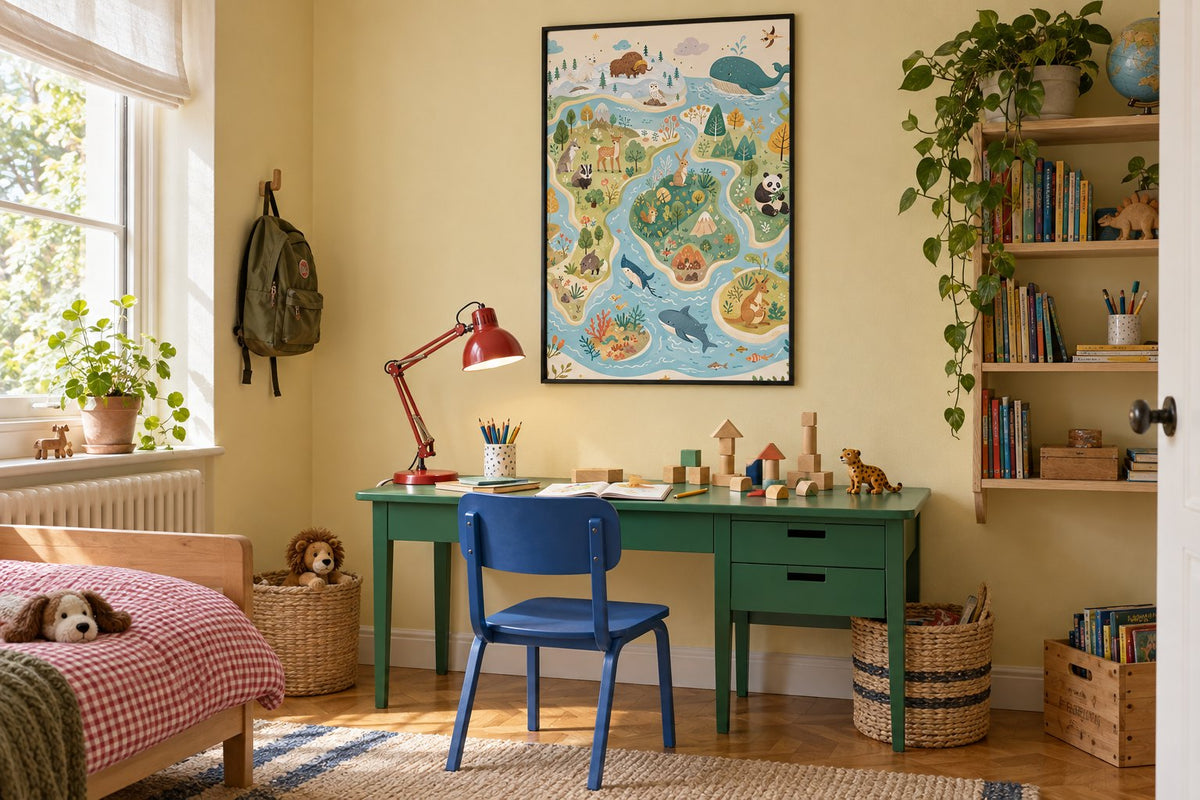
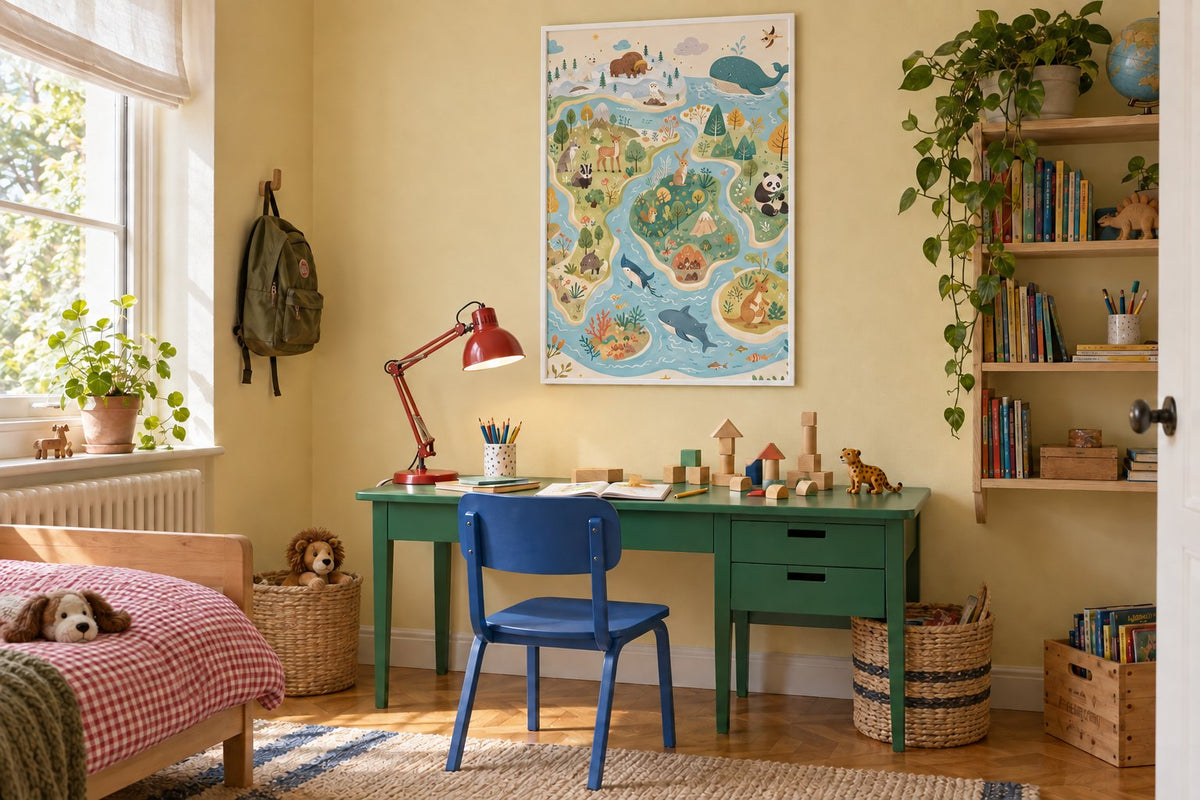
Both mockups keep the same green desk, blue chair, red lamp and yellow wall. The map of the world's animals stays in exactly the same position. Only the frame colour changes. In black, the outline defines the edge of the picture more strongly; in white, the border is less noticeable against the light wall.
Neither version requires new furniture. Compare this outline with the green prints, yellow prints or blue prints you are considering. Our guide to wall colours and choosing a print takes the comparison further. A favourite colour can appear in the picture alone, without repainting the whole bedroom.
Leave room for play and change
Avoid filling every patch of wall at the outset. Building projects, displayed books and objects brought back from outings already change the surroundings. Leave clear space near storage so doors open and tidying remains easy. Decoration works better when it supports the room’s everyday habits.
A sky, moon or animal can remain a favourite after the duvet cover changes. Moon prints offer another direction. If his interests turn to music, sport or a city, our guide to prints for a teenager’s bedroom takes over, without requiring you to turn his childhood bedroom into a teenage room today.
Check size and hanging before ordering
Measure the available wall, then check the sizes offered on the print’s product page and the dimensions of your chosen frame. Consider cupboard doors, switches and movement around the bed. A large frame should not obstruct the room or balance loosely on furniture used for play.
Choose fixings suited to the wall and frame weight, following the manufacturer’s instructions. Frames and hanging accessories complete the print. Install everything securely, away from areas where it might be knocked or handled. Position matters as much as the picture, especially in a small bedroom shared by several activities.
Start with the picture he really wants to keep
At Affichely, paper prints are made to order in our Fayence workshop, on 270 g semi-matte photographic paper with pigment inks. The subject remains your first choice: a picture that means something to him is better than a perfectly matched set he immediately tires of.
Let the new print live alongside his belongings for a few days. A cushion might echo a colour later, or everything around it might stay the same. His bedroom will already have gained a personal detail chosen together, with enough room left to read, play and grow.
Pictures he chooses with you
Animals, adventures and colours for his bedroom
Explore children’s printsFind a picture that makes him want to tell a story.
Explore children’s prints

