

How do you create coastal decor in your living room?

You want to bring a little holiday light home without filling the living room with shells and nautical objects. An image of a beach, the sea or a shoreline can already give the room that direction.
The result depends mainly on the landscape you choose, its dominant colour and its surroundings. Here we compare different ways to evoke the coast, then the same print on two walls, to help you build coastal decor that remains your own.
Choose the coast you genuinely enjoy
A rocky shore under breaking waves tells a different story from a pale beach. Start with this preference before choosing the frame. The Coastal collection brings together images with different atmospheres. If you mainly want a sense of open space, look at how much room is left for sky and water rather than the number of small holiday details.
Sea prints can show a calm horizon, a wave or a shoreline from above. A close-up subject takes on more of a patterned quality; a distant landscape invites the eye to move through several layers. To preserve that reading, choose a position where the image is visible from your usual seat. The subject should appeal to you both close up and from a distance.
Four images, four ways of seeing the coast
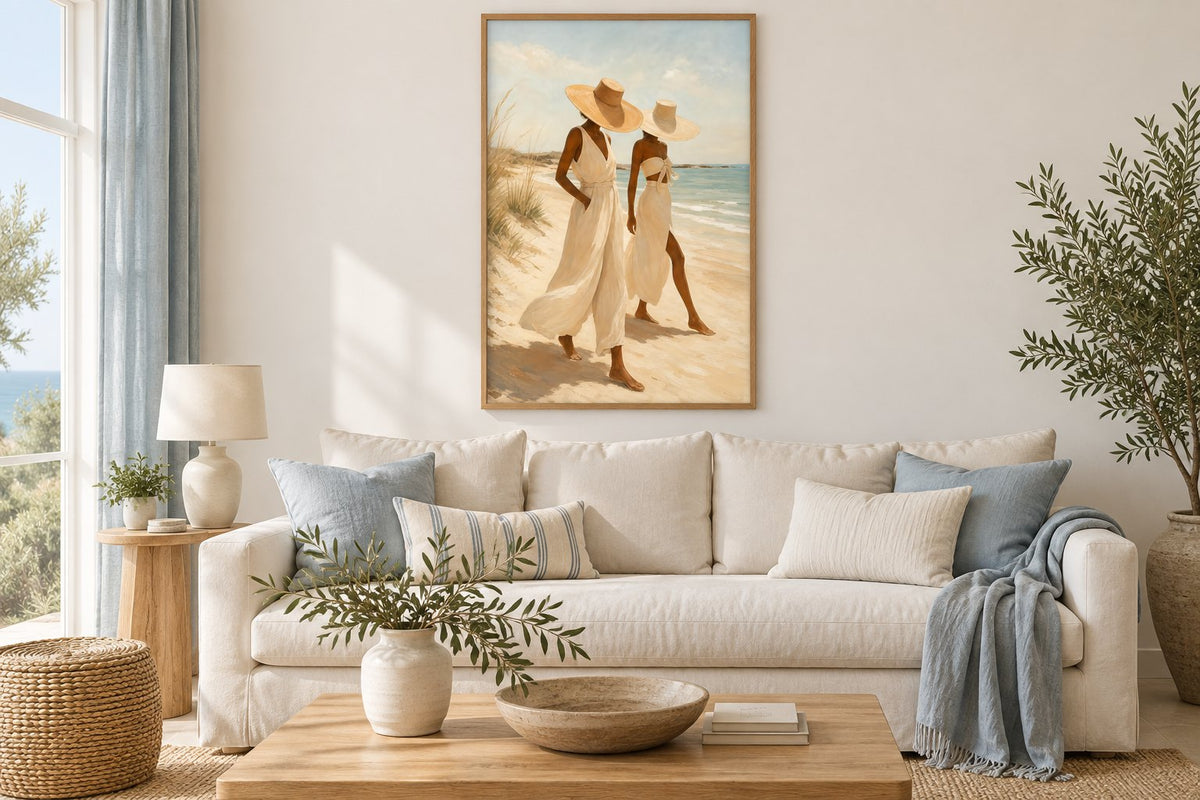
The straw hats on the beach shows two women in light clothing walking on sand, with a strip of pale green sea behind them. Their presence turns the landscape into a scene. Arch to the sea opens a turquoise view through a white arch: the architecture already frames the horizon within the drawing. These images serve different wishes, to tell a moment's story or to look out to sea.
The foam on the sand focuses on the meeting of sand and sea foam, with a more pared-back composition. Waves between the rocks brings indigo waves and rocks, creating stronger movement. Minimalist images and painterly prints help you refine the choice between an abstract beach, a painted scene and a detailed composition.
 The straw hats on the beachView the print
 Arch to the seaView the print
 The foam on the sandView the print
 Waves between the rocksView the print
Compare a white background with a stronger blue
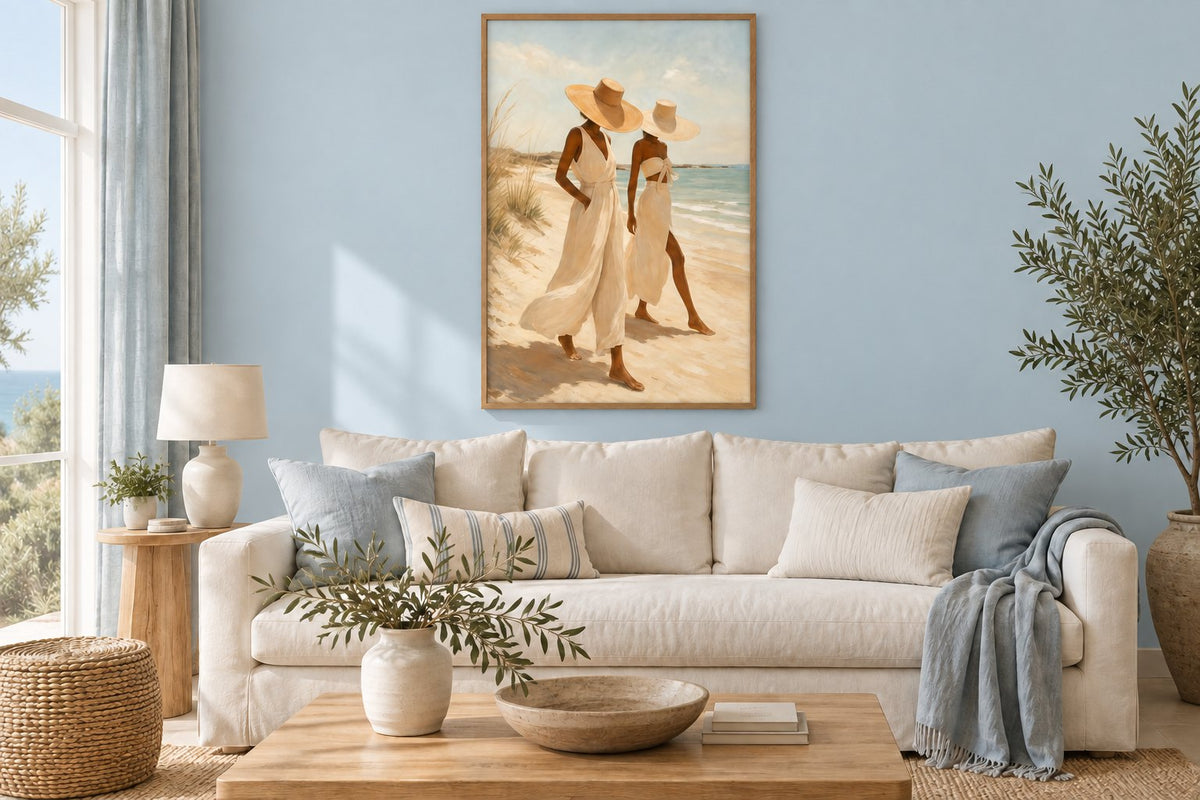
Our room visualisations keep the two women on the beach, their frame and all the furniture unchanged. On the white wall, the light clothing and sand continue the decor's tones. When the wall becomes a stronger blue, the print forms a more clearly defined bright area. The scene remains identical: its relationship with the background changes, not the colours within the picture.
A coastal living room can therefore remain mostly light or include a coloured wall. Blue prints offer other relationships between the sea and your interior. Before repainting, place a sample near the artwork and observe it at different times of day. The colour seen on a screen helps prepare the choice; it does not replace comparing it in your home.
Build the palette from the shoreline
Sand, pebbles and sea foam provide a broader palette than blue and white alone. Beige prints can accompany a linen sofa; green prints tend to echo shallow water or dune vegetation. Choose a shade already present in your curtains, rug or an armchair, then find it within the image.
If you prefer a cooler atmosphere, a black and white photograph can evoke the coast through light and texture. If you love pink-toned beaches, the romantic decorating guide shows how to use soft shades. None of these choices requires coordinating every accessory: a few visible connections already give the room a direction.
Let materials suggest the coast
Light wood, a soft textile and a ceramic object may be enough around the artwork. White prints support this search for related tones, while a dark frame creates a clearer boundary. Look at the frame and hanging options, taking the handles, lamp and other visible outlines in the room into account.
Above all, avoid hiding the shoreline behind objects on the furniture. A tall vase in front of the horizon can interrupt the most readable part of the image. Move it to the side before deciding to raise the frame. A collection of souvenirs can stay on another shelf: the print does not need to be surrounded by nautical objects for its connection with the coast to be clear.
Find the orientation that suits the available wall
A landscape-format print suits a broad wall; a vertical image can work between two windows. A shoreline does not always call for a horizontal composition: the women on the beach naturally occupy the height. Respect the chosen drawing's orientation and check the frame's outer shape with a template rather than relying only on a room photograph.
Living room prints should remain clear near the television and existing storage. If the room is compact, the guide to small living room walls helps you choose a priority area. One well-positioned image can evoke the coast more clearly than many small landscapes scattered through every remaining space.
Move from a mood to your own print
First choose the scene you like, then the role it will play: recalling a moment, introducing a colour or opening a view. Next, compare landscape prints with the furniture actually present in your home. Keep the artwork visible from the place where you spend time, and check reflections in daylight as well as with the lamps on.
Affichely paper prints are made to order in our Fayence workshop on 270 gsm semi-matte photo paper with pigment inks. Available formats and matching frames are listed on each product page. The coastal effect then comes from your combination: a carefully chosen landscape, a material that responds to it and enough space to let your gaze travel through the image.
Find your own stretch of coast
Beaches, shorelines and horizons to choose your living room's atmosphere
Explore Coastal printsA view of the coast, at home.
Explore Coastal prints

