

What size print should you hang above a sofa?

A print can look large on a product page and seem small above your sofa. The useful question is how much space it will occupy in the room, including its frame and the furniture around it.
Here are some width guidelines, simple calculations and two visualisations to help you compare sizes before ordering.
A starting point: 60 to 75% of the furniture’s width
Judge a print’s size in relation to the furniture, the available wall space and your viewing distance. For an initial trial, try an arrangement spanning around 60 to 75% of the sofa’s width. This includes the frames and the gaps between them.
This range is a decorating suggestion, not a requirement. A small artwork can provide a deliberate accent, while a larger group can occupy more of the wall. Compare both from the position where you will usually view the pictures.
These examples use portrait prints. The widths below include the specified gaps, but you still need to add the frame mouldings:
- A 210 cm sofa: the initial range is 126 to 157.5 cm. A 70x100 print flanked by two 30x40 prints, with two 5 cm gaps, spans 140 cm before adding the mouldings.
- A 160 cm sofa: the guideline is 96 to 120 cm. Two 50x70 prints separated by 6 cm occupy 106 cm before adding the mouldings. Check the combined external width of both frames.
- A 140 cm bed: the guideline is 84 to 105 cm. Three 30x40 prints separated by 5 cm occupy 100 cm before adding the mouldings, which may take the framed arrangement beyond that range.
- A 160 cm bed: two 50x70 prints separated by 6 cm occupy 106 cm before adding the mouldings. A single picture is also an option if you prefer more empty wall space.
- A 120 cm console or desk: three 21x30 prints separated by 6 cm occupy 75 cm before adding the mouldings. A portrait 70x100 print is 70 cm wide before framing.
The calculation is simple: add together the frames’ external widths and then the gaps between them. The percentage helps you compare options; the actual dimensions of your chosen arrangement determine the space it needs.
The same arrangement, twice
The following visualisations show the same selection of pictures in smaller and larger sizes. They let you compare the group’s visual presence. For an accurate measurement at home, use the dimensions of the prints and frames, then mark them out on the wall.
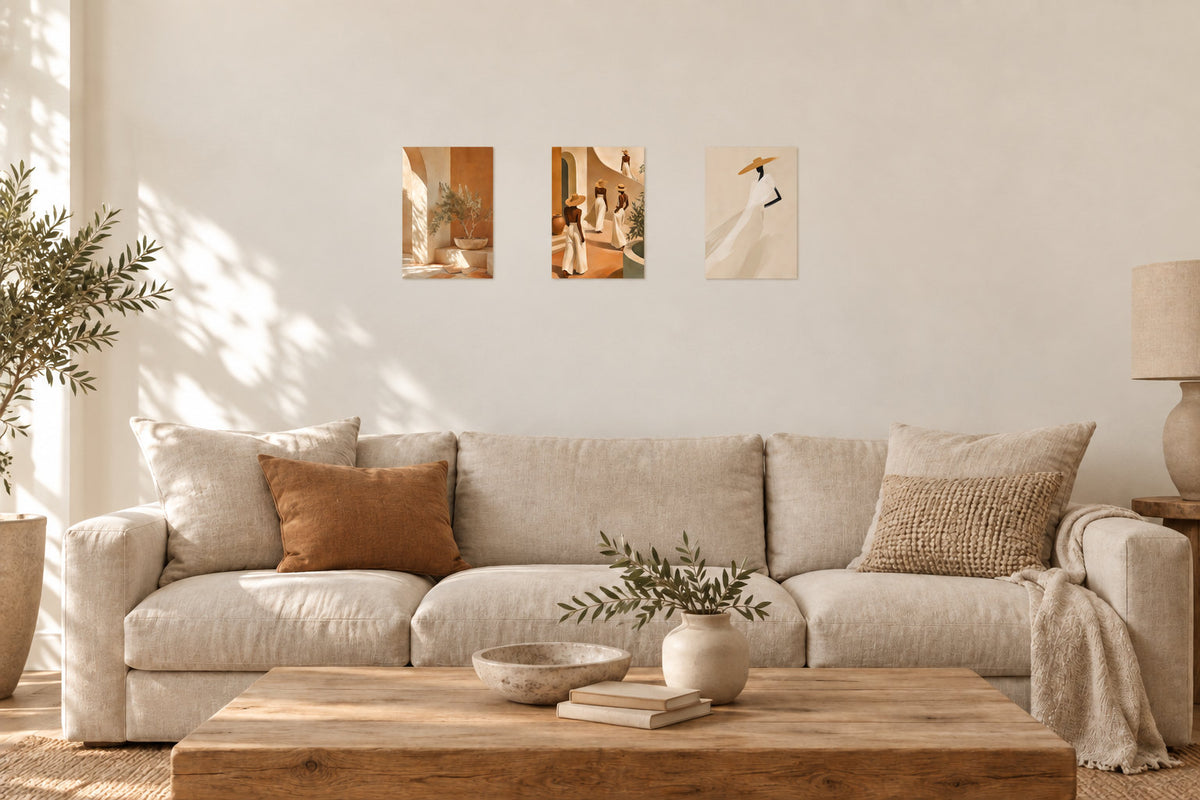

A product preview cannot show the scale of your room. Paper rectangles or a mock-up based on your measurements can help you choose between two similar sizes.
How high should you hang it?
On an empty wall, placing the centre around 145 cm above the floor gives you an initial reference to adjust. Above a sofa, the position of the backrest and the view from your seat matter more than applying the same height everywhere.
Two situations deserve a separate trial:
- Above furniture: try a gap of 20 to 30 cm between the furniture’s upper edge and the bottom of the frame. Check that the frame clears seated people’s heads and any objects placed on the furniture.
- In a room used while seated: in the dining room or at your desk, look at the print from your usual position before fixing its height.
With several frames, consider the centre of the whole group. Aligning each centre at the same height creates a row; an arrangement across two levels requires you to consider its overall outline.
Our four print sizes and where each can work
The four paper sizes are 21x30, 30x40, 50x70 and 70x100 cm. They do not correspond exactly to A4 and A3. Check a separately purchased frame’s stated internal dimensions and whether it includes a mount before choosing it.
- 21x30: a small accent beside a shelf, or a series for a gallery wall. The pictures in the decorating trends selection offer several palettes to compare.
- 30x40: a size for narrow spaces, hallways, the kitchen or the wall between two doors.
- 50x70: a size to consider in a bedroom or living room, alone or in a pair. How well it fits depends on the width of your furniture.
- 70x100: a stronger presence for a single picture or the centrepiece of a group. In portrait orientation, it is still 70 cm wide before framing, so it does not automatically fill the space above a large sofa.
A frame increases a print’s overall dimensions. The difference varies with the moulding, so use its external measurements instead of assuming that every frame adds the same amount.
Prints for the living room
Subjects and sizes for the space above a sofa.
Explore living room printsOne large print or several smaller ones?
One large picture and several smaller ones can span a similar width while creating different effects. The choice also depends on whether you want one artwork to stand alone or prefer to bring several subjects together.
One large print creates a single focal point. Depending on the available orientations, it might feature a horizontal landscape, an abstract composition or a portrait. Allow enough viewing distance to appreciate the whole picture.
Several smaller prints let you bring together different subjects and later replace just one picture. A repeated colour or frame finish helps connect them. The guide to choosing prints for your wall colour can help you refine the palette.
The three most common mistakes
Choosing only on screen. Mark the dimensions on your wall before ordering. Compare the result from the doorway and from your usual seat.
Hanging without considering the furniture. In the living room, check the relationship between the frames and the sofa back before drilling.
Forgetting the mouldings. Add up the external dimensions and the gaps. If the wall is narrow, a black and white pair or small botanical pictures can offer another arrangement.
See the prints selected for a living room.
Explore living room prints

