

Which animal picture belongs in your living space?

You love animals, but want a picture for your entrance or living room? The subject alone does not decide the result. A cat drawn among flowers, a photographic portrait and an ink silhouette create three very different presences on the wall.
Start with the image’s style, then consider its place in your room. Here are four prints to compare and two mockups showing what the frame changes around the same cat.
Choose a presence rather than a symbol
An animal on the wall can recall affection, a walk or simply a shape you enjoy. It does not need an obligatory meaning. Among animal pictures, look first at posture: a still body, a gaze towards you or moving wings attract attention in different ways.
Cat prints range from decorative patterns to everyday scenes. Dog prints also let you choose a breed or pose without turning the living room into a gallery of pet portraits. One personal picture can be enough. Keep some distance from poetic titles: the visible drawing is what you will actually see each day.
Distinguish photography, drawing and decorative pattern
A photograph often highlights fur texture, the detail of an eye or subtle differences in light. Photographic prints suit you if that precision matters. A simpler drawing can instead leave large areas open. Line art prints are chosen for their outlines as much as the animal they represent.
An illustration can alter proportions, invent a scene or combine motifs. Illustrated prints offer that freedom. The choice is not simply realistic or childish: a cat drawing with large red colour fields can have a strong presence in an adult room. Compare the entire image, including its background, before deciding whether the subject suits your decor.
Look at the animal and the space around it
An isolated horse against a dark background reads differently from a herd in a landscape. Horse pictures let you compare silhouette, movement and the role of the setting. Does the body fill most of the print? Is there sky or open background left? These questions help you judge its presence from the sofa.
With bird prints, notice the rhythm of wings and branches. Several birds do not necessarily need several frames: a single composition can already form a group. In a small room, fine lines are mostly enjoyed close up, while blocks of colour remain visible from the entrance. Choose for the distance from which you actually enjoy the picture.
With an elephant print, look at the bulk of the body and the space left in the background: a lone silhouette and a herd have different presences on a wall. For a tiger poster, compare the stripes with the patterns on your rug or cushions. A whale print instead draws attention to the line of the body and the space around it, whether it is a vintage natural history illustration or a marine scene.
Four animals, four styles of picture
The cat curled among tall poppies shows an orange and white cat among large flowers and dark green leaves. Pattern fills almost the whole surface. Dancing swallows shows three black swallows flying among stems and flowers against a light background. The movement of wings matters more here than the gaze of one animal.
Piebald Horse in Moonlight depicts a black and white horse against dark green, with a moon and yellow details. The scene is decorative, not a horse photograph. Dachshunds on a Naturalist Plate gathers dachshunds in several poses, in brown, black and grey against a light ground. This illustrated sheet keeps open space between the dogs. Choose how the animal is depicted as carefully as the animal itself.
 The cat curled among tall poppiesView the print
 Dancing swallowsView the print
 Piebald Horse in MoonlightView the print
 Dachshunds on a Naturalist PlateView the print
Compare two frames in the same entrance
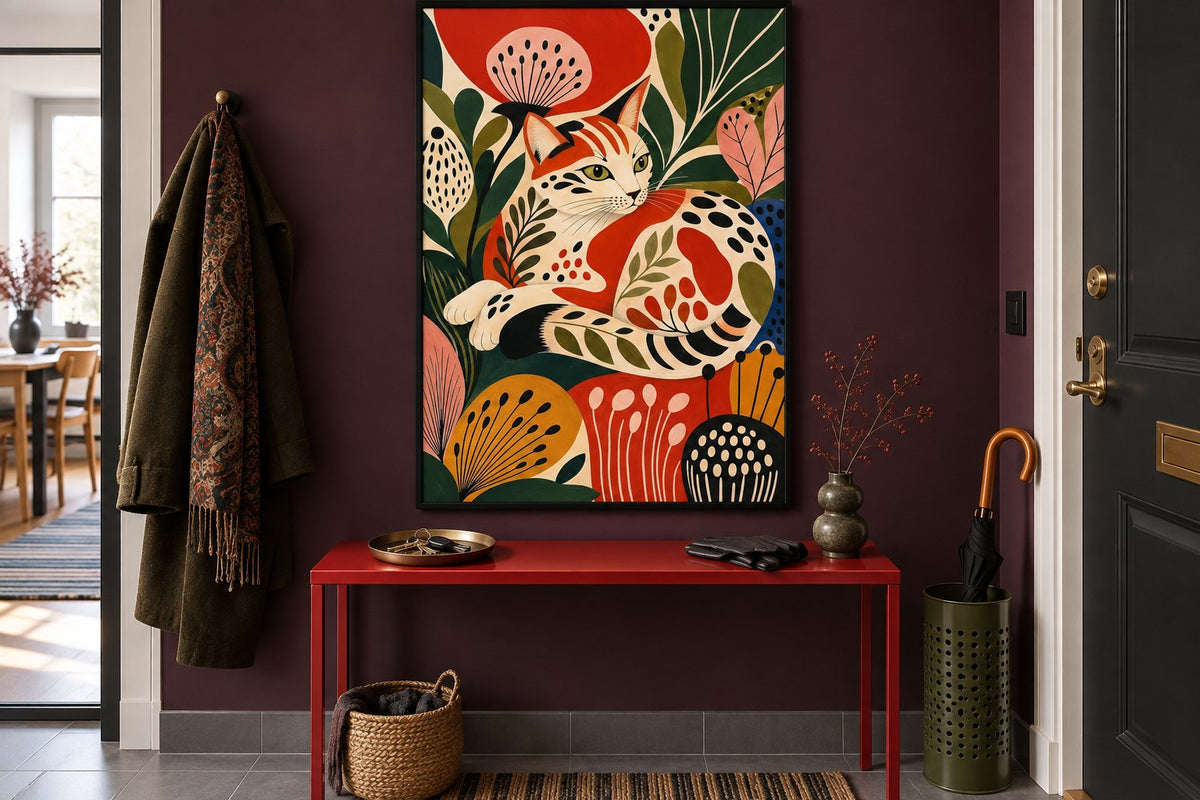
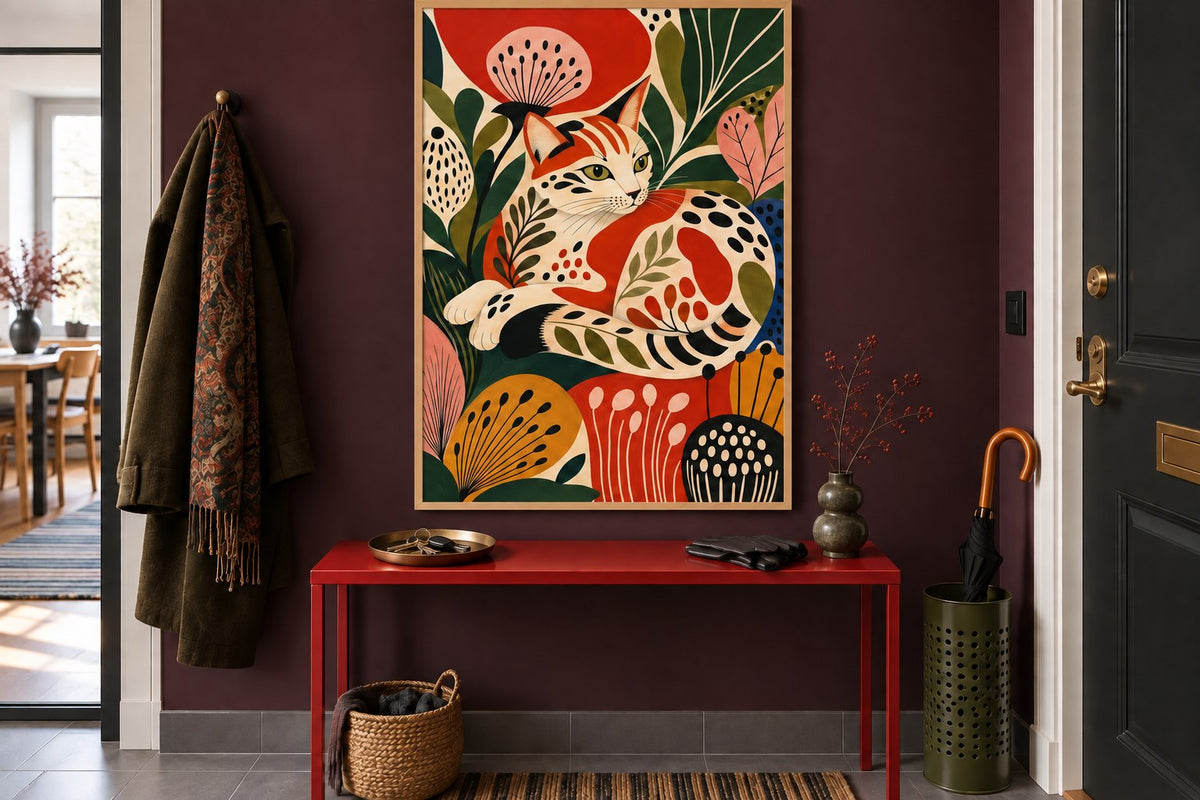
Our mockups show The cat curled among tall poppies above a red console against an aubergine wall. The cat and every flower remain identical. Only the frame changes: black in the first scene, pale wood in the second. Black extends the picture’s darker details; wood introduces a lighter outline around this dense composition.
The console, keys, gloves and lighting stay in place to make the comparison clear. Among red prints and green prints, look for an echo that already exists at home. The picture need not repeat every furniture colour. Two or three connected details already give the arrangement a direction.
Find a place in an adult room
In an entrance, the picture can appear as soon as the door opens. Preserve room for coat hooks and objects left on the console. Choose hallway and entrance prints with that passage in mind. Our guide to an entrance wall with a console helps keep a clear relationship between furniture, frame and daily use.
In the living room, view the composition from your usual armchair. Living room pictures can feature an animal without adding sculptures or cushions in the same theme. If the wall is short, our guide to pictures for a small living room helps create a clear presence without scattering images around every piece of furniture.
Choose the print and leave room for the picture
Check available dimensions on the print’s product page, then the outside dimensions of the frame. Frames and hanging accessories complete the choice for your wall. A strong outline can accompany a dense drawing; a quiet finish leaves more room for the subject. Above all, avoid a lamp, plant or pile of books hiding the part you liked.
Affichely paper prints are made to order in our Fayence workshop on 270 g semi-matte photographic paper with pigment inks. Before arranging a series, start with the animal whose depiction you really enjoy. A well-chosen picture can stay when furniture or textiles change, because your connection to the image goes beyond matching a cushion.
An animal, a picture that speaks to you
Drawings and scenes for your living space
Explore animal wall artChoose a presence you enjoy every day.
Explore animal wall art

