

Can you hang a print in a bathroom?

A print can decorate a bathroom, but the choice starts with the conditions in the room. Prolonged humidity, condensation and splashes can damage a paper print, even when it is framed.
Before choosing a marine or botanical subject, observe the proposed position. Here are the material’s limitations and several ideas for decorating a wall where conditions allow you to display paper.
Humidity, condensation and splashes: three things to observe
Bathroom air does not necessarily become dry between showers. This depends partly on ventilation and how the room is used. Prolonged humidity can distort or damage paper, even without visible droplets. Condensation and splashes add direct contact with water.
Look at the wall during and after a shower, then at different times of day. Identify damp surfaces and areas that dry slowly. The absence of splashes at one particular moment is not enough: if the proposed position stays humid, choose another wall or another room.
What the paper and inks tell you
Our paper prints are made to order in Fayence on 270 gsm semi-matt photographic paper using pigment inks. These characteristics describe the paper and printing. They do not provide waterproof certification or a guarantee of suitability for damp conditions.
The paper is not waterproof, and framing does not make it impermeable. We do not have a measured humidity resistance duration to state. The fine art or photographic paper guide explains the finish and paper weight; neither replaces choosing a dry position.
Where should you hang a bathroom print?
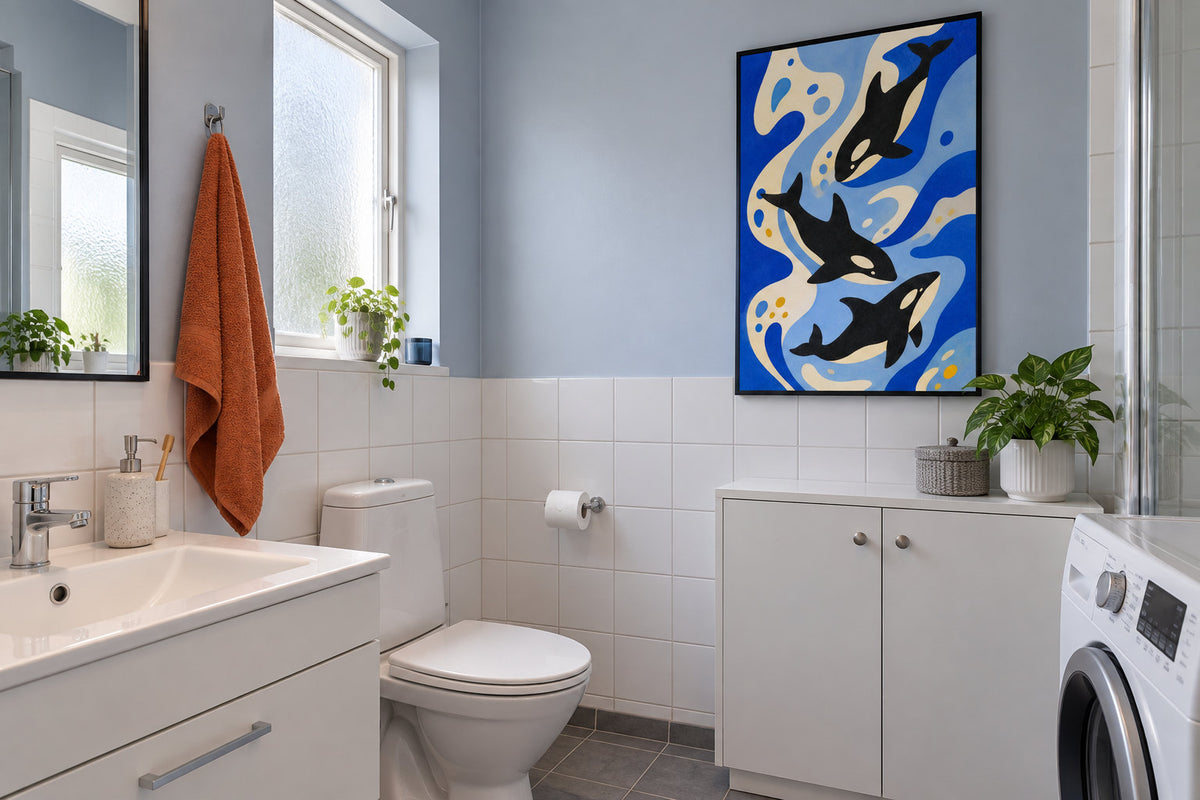
A wall near the vanity unit can be visible every day, but it is not automatically dry. Check splashes from the basin, moving towels and proximity to the shower. A section of wall away from water use may offer another possibility if the air does not remain humid.
Three checks help you compare positions:
- Avoid splashes and steam: keep away from shower walls and areas above the bath that are exposed to water. A distance of one metre does not guarantee protection: layout and use matter more.
- Watch for condensation: a cold wall can become damp even far from the shower. If water regularly collects there, or the paper distorts after installation, remove the print from that position.
- Try the hanging height: choose it according to the furniture, mirror and your viewpoint. A template helps you check the space without assuming a universal height from the guide to print sizes above furniture.
A frame covers the front of the print but leaves the assembly sensitive to humidity. Choose fixings appropriate to the wall and weight; consult the wall hook instructions. Our print frame guide explains dimensions and finishes.
Which subjects work in this room?
Pictures of the sea and beach can echo the water, while botanical subjects or flowers introduce plant forms. Compare their colours with the tiles and textiles. Blue prints and the coastal collection provide starting points without requiring an entirely nautical room.
 Whales in the seaweed
View the print
Whales in the seaweed
View the print
 Orcas in the current
View the print
Orcas in the current
View the print
 The foam on the sand
View the print
The foam on the sand
View the print
 Mediterranean Terrace over the Sea
View the print
Mediterranean Terrace over the Sea
View the print
You can also choose an animal picture with a touch of humour or a black and white drawing. Look at the subject’s size and contrast from the doorway. The choice of subject reflects your taste; it does not change the paper’s resistance to humidity.
 Okapi in a bubble bath
View the print
Okapi in a bubble bath
View the print
 The cat in the bathtub
View the print
The cat in the bathtub
View the print
 Morning Ritual
View the print
Morning Ritual
View the print
 The barrel in the sun
View the print
The barrel in the sun
View the print
For a specific marine subject, whale prints let you compare silhouettes and backgrounds. A pale subject against a dark background, or the reverse, can remain legible from a distance. You might pick up a blue from the towels without trying to match every accessory exactly.
What size fits the available wall?
Measure the wall around the mirror, shelves and furniture. A portrait 30x40 print occupies 30 cm in width before framing. Two portrait 21x30 prints separated by 5 cm span 47 cm before adding the mouldings. These examples offer an initial comparison; the required space then depends on the frames’ external dimensions.
The available paper sizes are 21x30, 30x40, 50x70 and 70x100 cm. On a wider wall, a single picture or a group of frames are both possible. Compare the bathroom selection with the bedroom collection to find a palette, then assess the position separately.
In a separate toilet, a small print can decorate the wall facing the door. The toilet print collection also includes humorous subjects. Keep controls, service access and the space needed for cleaning clear.
The guide to decorating a toilet with prints explores the choice of subject and size. A room without a shower may be easier to decorate, but the print’s position still needs to remain dry.
Prepare the arrangement and keep an eye on the print
First try the arrangement with paper templates. Then check that the fixings are suitable for the tiles or wall, without assuming an adhesive works everywhere. After installation, observe the frame and print. If you see condensation, marks or distortion, move the print to a dry place.
Prints for the bathroom
Compare subjects and sizes for a dry position away from condensation and splashes.
Explore bathroom printsChoose a subject for a dry spot in your bathroom.
Explore bathroom prints

