

What should you hang on a brick wall in an industrial interior?

Your brick wall already has texture, lines and several shades. When hanging a print, first look for an image whose subject remains clear against that material. A graphic facade, a city view or a few large shapes can work.
The frame can then connect the image with metal furniture or separate it. Here are four architectural directions and a comparison of the same arrangement with a black border and then a white one.
Read the wall before adding an image
Joints make a grid, and individual bricks have irregularities. A print full of tiny details can compete with this background. Among our architectural prints, compare large openings, areas of sky and outlines. A close-up facade plays a different role from an urban view containing many buildings.
Also consider what stands in front of the wall: metal shelves, exposed pipes, an articulated lamp or the back of an armchair. Keep an area where the frame edges remain fully visible. Our city prints can bring a personal memory; choose a composition that makes the place recognisable from your usual seat without having to approach the wall.
Connect materials without recreating an entire workshop
An industrial interior does not need endless factory images or workshop objects. Brick and furniture may already carry that atmosphere. A street view, window or geometric structure offers a different perspective. Our Stuttgart prints, for example, offer urban subjects to choose for their drawing or your connection to the city.
Our geometric prints can echo steel window bars without depicting a particular building. Our modernist prints offer other relationships between lines and blocks of colour. Keep useful objects: a reading lamp and books make the room liveable. Accumulating purely decorative accessories could make the wall harder to read.
Four architectural images to compare
Rounded Brick Facade in Mulhouse depicts a curved red-brick facade and a large window, with light surfaces and dark lines. It echoes the wall’s material while simplifying it. Stuttgart Behind a Half-Open Door shows a view of Stuttgart through a partly open dark door, with a tower and other buildings. This image offers greater depth and a more explicit connection with a place.
Tower, Black Circle and Stone Arch combines a pale tower, an arch and a large black circle on a grey background with a drawn texture. This geometry suits a preference for volumes over city detail. The Black-Domed Observatory depicts a black-domed observatory, a blue telescope and orbital shapes against a light background. Its horizontal composition relates differently to a low cabinet; check the available format on the product page before deciding.
 Rounded Brick Facade in MulhouseView the print
 Stuttgart Behind a Half-Open DoorView the print
 Tower, Black Circle and Stone ArchView the print
 The Black-Domed ObservatoryView the print
See what frame colour changes against brick
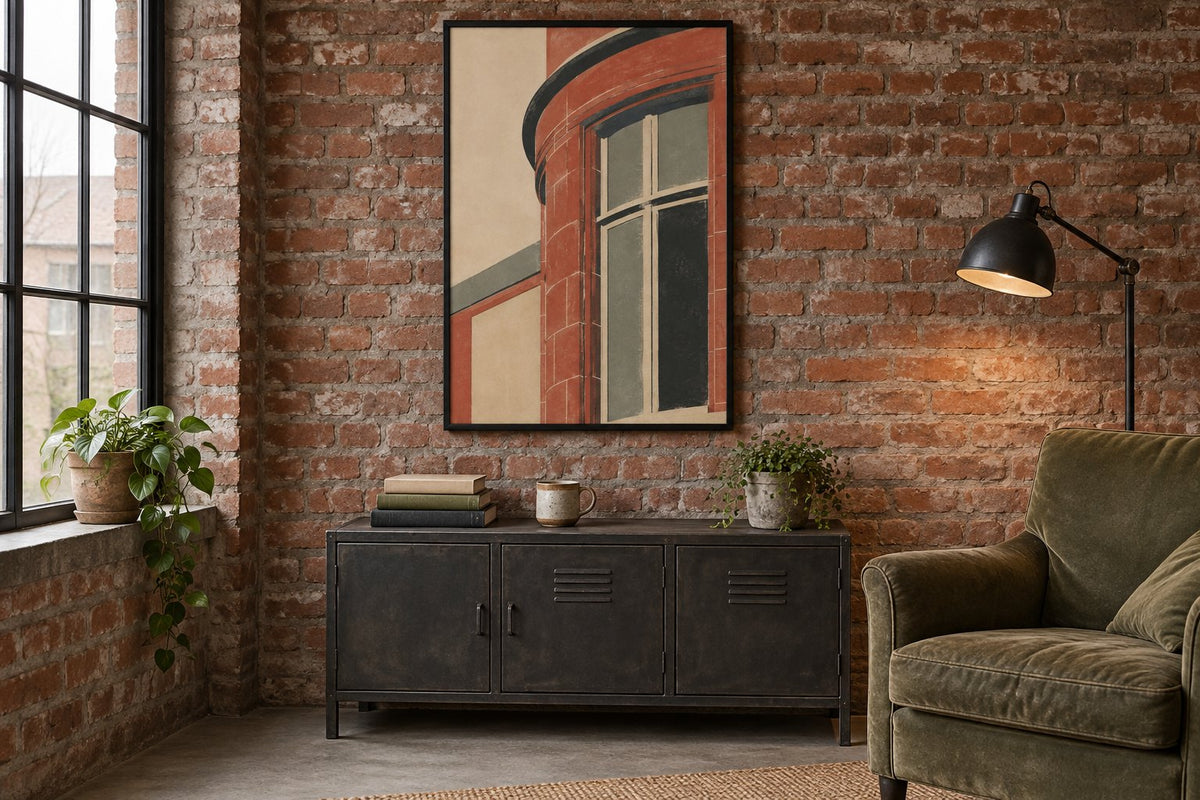
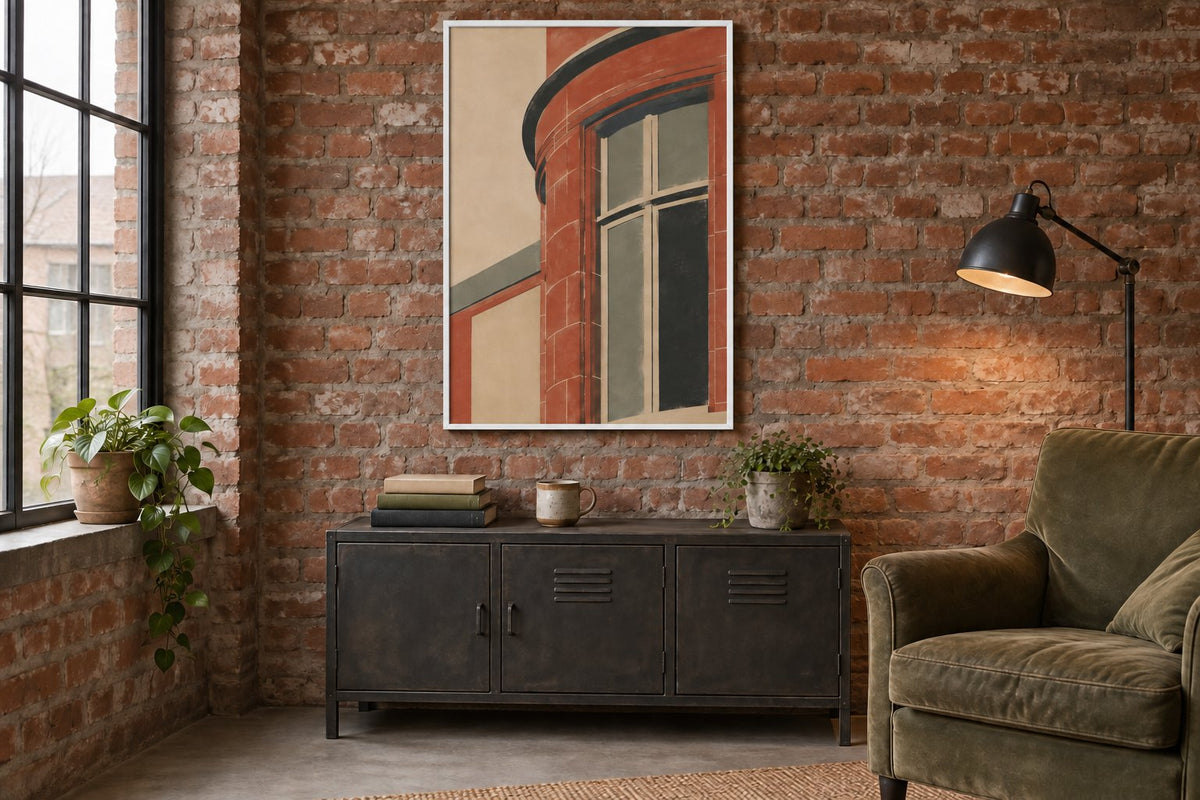
Our simulations show the same reading corner: red brick wall, dark metal cabinet, olive armchair, books and lamp. Print Rounded Brick Facade in Mulhouse remains identical. In the first image its black border connects with the room’s metal elements; in the second only that border turns white. The light outline separates the rectangle more clearly from the irregular background.
This choice depends on the result you prefer, not a rule imposed by industrial style. A black frame can extend our black and white prints, while a light edge creates separation. Our guide to matching a black and white print to its wall explains how to assess these boundaries in your actual lighting.
Choose between echoing brick and creating contrast
A red or ochre image echoes the wall’s visual warmth, but its outlines must remain distinct. Our red prints and terracotta prints can work when light or dark areas surround the subject. Compare the amount of red rather than searching for a shade identical to every brick.
Our grey prints relate more closely to concrete and certain metals. They need not fill every wall: a green armchair or colourful book can stay. On a large brick surface, gather images in a legible area. Our article on decorating a large wall without scattering pictures helps define that area and its boundaries.
Check hanging against your actual wall material
Before drilling, identify the support and select fixings suitable for the wall, frame weight and hanging system. Solid brick, hollow brick and brick slips do not automatically require the same method. If the support is uncertain, have the fixing checked. Our frames and hanging accessories show available components to complete your print.
Choose our living room prints with viewing distance and window reflections in mind. Avoid placing the subject behind a lamp or too near a heat source. For our office prints, a side wall may work better than an area already occupied by shelves. Measure the frame’s outer dimensions, not only the image itself.
Let the room keep its character
An architectural print can join older furniture, weathered metal and a colourful seat without reproducing a catalogue setting. Choose the building, drawing or perspective that truly interests you. Affichely paper prints are printed to order in our Fayence workshop on 270 g semi-matte photo paper with pigment inks.
Start with this arrangement alone, then observe the wall in daylight and by your evening lamp. Add another image only if it brings something different. Brick remains part of the composition: leaving it room also lets you enjoy what you already like about the space.
Architecture meets your interior
Facades, perspectives and shapes to suit your wall
Explore architectural printsFind an image whose lines speak to you.
Explore architectural prints

