

How do you create soft, personal nursery decor?

You have chosen the cot and put away the first clothes, but the nursery walls are still waiting to take shape. You want gentle decor that feels personal enough to enjoy today and flexible enough to evolve later.
A print can provide the starting point. Here is how to choose its theme, pick up its colours and make room for frames without multiplying patterns throughout the room.
Start with an image rather than a complete theme
The room can evoke a forest without turning every object into an animal. Start with the subject you want to look at: a fawn, a giraffe, a landscape or simple shapes. Nursery prints let you compare these worlds with the furniture already chosen. Then keep one main motif and a few subtle echoes.
Personal decor can also begin with a memory: a walk, a favourite animal or a colour in a blanket. Baby animal illustrations bring instantly recognisable characters; children's prints open more imaginative possibilities. You can keep the furniture simple so the images can easily accompany changes in the room.
Four directions to find the right tone
The fawn in the leaves pairs a little fawn with orange and sage tones. The giraffe on a scooter introduces an amusing scene and movement. Trio of the undergrowth brings several animals together in a woodland setting. The duckling in boots offers a cheerful character with stronger touches of colour. Look at the backgrounds too: their presence changes the overall impression as much as the subject itself.
For a nursery with patterned bedding, just one of these prints may be enough. If the textiles are plain, you can consider a pair with one clearly shared feature. The animal prints collection helps you compare characters, while illustrated prints let you choose a style of drawing you truly like.
 The fawn in the leavesView the print
 The giraffe on a scooterView the print
 Trio of the undergrowthView the print
 The duckling in bootsView the print
Cream or sage: a comparison in the same nursery
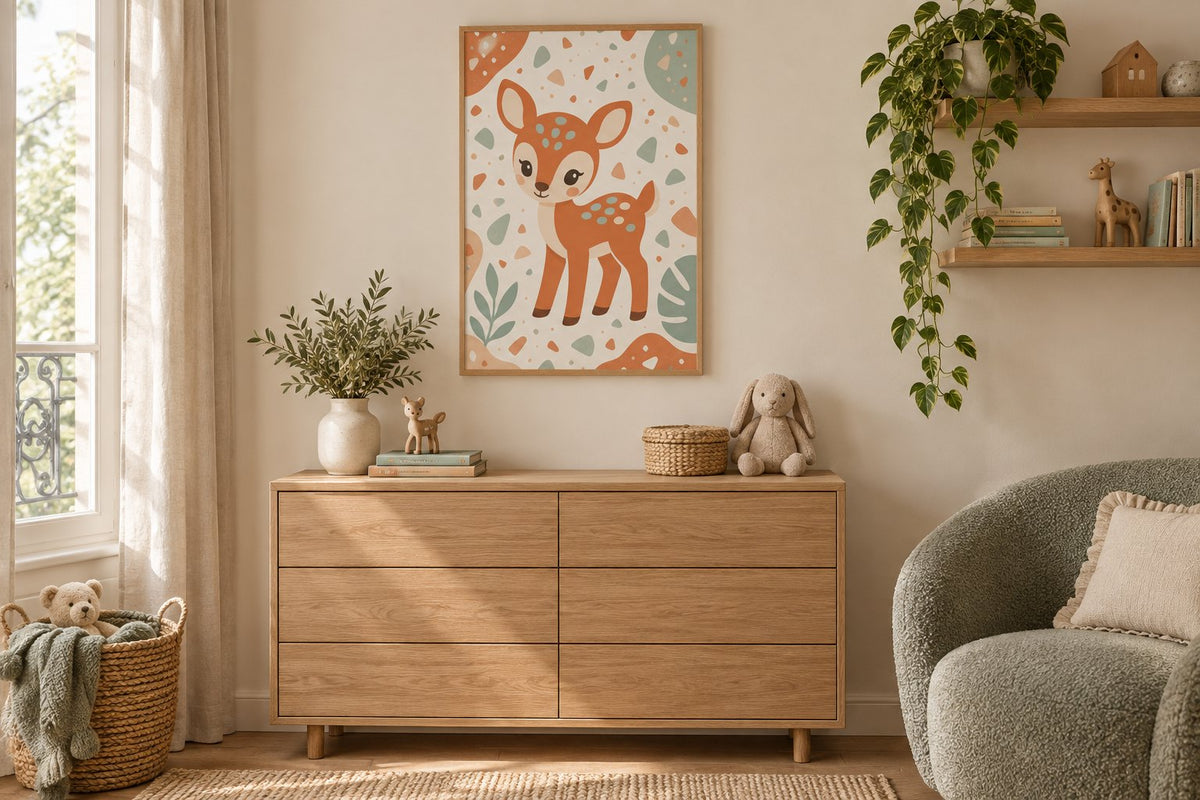
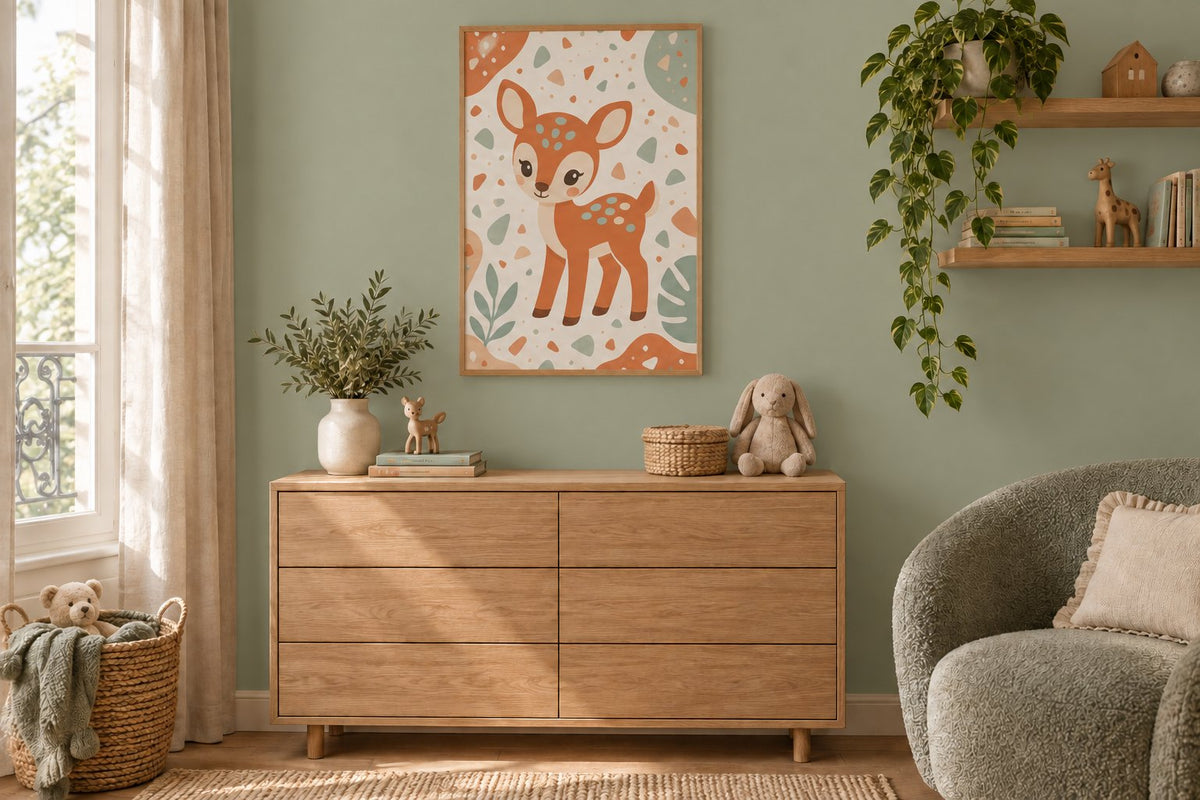
Our two room visualisations show the same framed fawn above a storage unit. Only the wall colour changes. On cream, the print's light tones continue the room's background. On sage, the drawing's green touches find an echo and the image's light boundary becomes more prominent.
These images offer a decorating direction; they do not predict exactly how a paint will look in your home. Try a sample beside the wood and textiles, first in daylight and then in evening light. Green prints can accompany a natural base; beige prints leave more room for a colourful textile.
Choose colours that work with the furniture
List the large surfaces already present: the floor, cot, chest of drawers and curtains. A print that repeats two of these tones fits in easily. Another colour can then become the room's accent. You do not need to assign a palette automatically to a girl or a boy: start with the shades you enjoy together.
A cream background and wood can welcome green, yellow or greyish blue. White furniture also works with a more strongly contrasted drawing. Blue prints and botanical motifs offer alternatives to characters. Decor does not guarantee any effect on sleep; its role here is to build a pleasant and coherent visual whole.
Find the frame's position before choosing its size
Look at the wall from the entrance and from the armchair. A section above storage can accommodate the image without crowding the cot area. Avoid placing a heavy frame above the sleeping space or within reach of small hands. The fixing must suit the wall and the total weight; check its stability as the arrangement changes too.
The paper print formats offered are 21 × 30, 30 × 40, 50 × 70 and 70 × 100 cm. A template matching the frame's outer dimensions shows what really fits. A small format is viewed close up; a larger subject can be seen from the doorway. Keep cords and hanging elements out of reach.
Let the decor evolve without starting again
Choosing a simple frame and a shared palette lets you change an image later. A nursery can eventually welcome more storytelling animal scenes, landscapes or the child's first interests. Children's bedroom wall art continues this approach without requiring new furniture and accessories throughout.
To help you balance plant patterns, the guide to botanical prints in the home compares fine drawings with more decorative ones. If you like natural textures and earthy colours, our guide to creating bohemian decor offers combinations that can be adapted to the bedroom, while keeping useful surfaces clear here.
Check the whole room before deciding
Before ordering, bring together a photo of the wall, the textile colour and your chosen image. Check what dominates: the print should have a clear place among everyday objects. Forest prints suit a natural theme, but a room can be just as coherent with a single character and a few colours repeated elsewhere.
Affichely paper prints are made to order in Fayence on 270 gsm semi-matte photo paper with pigment inks. Consult the design's product page to choose the medium and format offered. Start with this main image, then add only what gives it a place in the room: a suitable frame and one repeated colour are often enough.
A first world for their bedroom
Animals and colours to pair with the decor you have chosen
Discover nursery printsA picture for their first bedroom.
Discover nursery prints

